Showing posts with label food security. Show all posts

Thursday, September 11, 2014

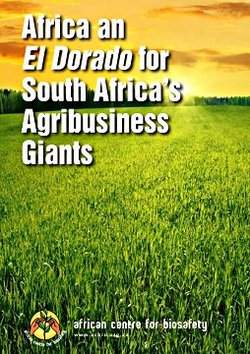
Africa an El Dorado for South Africa’s Agribusiness Giants


African Centre for Biosafety | 9 September 2014


The ACB has today, released its new report titled, "Africa an El Dorado for South Africa’s Agribusiness Giants," which shows the extent to which South African agribusinesses dominate the farm to fork agribusiness value chain in Africa-worth billions of dollars.

 Tiger Foods, Pioneer Foods Group, Tongaat Hulett, Astral Foods, AFGRI, Illovo Sugar, Anglovaal Industries (now AVI), Rainbow Chicken (RCL Foods), Clover Holdings and Oceana Group are among the top 20 African businesses operating on the continent. Shoprite, South Africa’s biggest supermarket retailer, already holds 34% of the continent’s supermarket sector. Seven of the ten leading agribusinesses (Tiger Foods, Premier Foods, AFGRI, Illovo Sugar, Astral Foods, Clover Group and Tongaat Hulett) are backed by the South Africa government-owned Public Investment Corporation (PIC), which is responsible for managing the South African Government Employees Pension Fund (GEPF), the Unemployment Insurance Fund (UIF) and the Compensation Commissioner’s Fund.

 These agribusinesses benefit enormously from access to private capital, experience, established distribution chains and both direct and indirect subsidies and incentives offered to them. There are several implications stemming from South African agribusiness expansion onto the continent, including entrenching a culture of corporate consolidation, blocking the emergence of small operators and producers, depressing local innovation systems and negatively impacting on food security.


from here

Download full report here


Thursday, May 22, 2014

New Alliance For Food Security And Nutrition In Africa


Two weeks before the G7 Summit of June 4, 5 in Brussels, FIAN International raises grave human rights concerns about the G8 initiative "New Alliance for Food Security and Nutrition in Africa" in a policy paper published today.
Titled "G8 New Alliance for Food Security and Nutrition in Africa: A Critical Analysis from a Human Rights Perspective", the policy paper argues that this initiative ignores general human rights principles and contradicts a human rights-based framework in key issues relevant for those most affected by hunger and malnutrition: small-scale food producers. FIAN calls on the G8 governments to stop this public-private partnership initiative that includes more than 150 companies - among them the biggest transnational corporations in the food and agriculture sector. Moreover, FIAN highlights the G8 initiative also ignores general human rights principles, like effective participation, and lacks human rights risk analyses and reference to adequate accountability mechanisms.

FIAN criticizes the G8 initiative as bluntly equating the opening of agriculture and food markets to foreign investors with combating hunger and malnutrition. An explicit expression of this erroneous understanding is the "success" indicators of the initiative: in most of the New Alliance Cooperation Frameworks for countries, the World Bank Doing Business Index and "increased private investments" are the key indicators. This alone shows the initiative is excessively biased towards the corporate sector.

FIAN's policy paper directly contrasts policy actions of the G8 initiative in four key areas: seeds, land, social protection/income, and nutrition with a human rights framework.
The results speak for themselves: For example, where the UN-Special Rapporteur on the Right to Food asks governments to implement farmers' rights (as defined in the International Treaty on Plant Genetic Resources), the G8-led initiative pushes for the "implementation of national seed regulation" for greater private sector involvement.
Similarly, where the human right to adequate food and nutrition includes improved access to land for small-scale food producers "to feed oneself" and for those groups directly affected by land grabbing, the corporate-driven agenda of the G8 initiative is concerned about an easy and cheap process of land allocation for investors.

An increase of private sector involvement is furthermore evident in the area of social protection - an area which has traditionally been the sole responsibility of the state. The role of the state in relation to social protection is reduced through the creation of a climate beneficial to foreign investment by formulating corporate-friendly policy frameworks and opening up social protection-related areas to private investors. Also, the income-generating measures propagated by the G8 need to be assessed carefully due primarily to the fact that the strategy of the Alliance is geared toward land acquisition for private corporations focusing on large-scale, capital-intensive, and extensive agriculture which requires reduced labor input. Furthermore, the G8's simplistic understanding of the nutritional dimension of food production has resulted in the proposal of a limited economic model. It neglects the fact that food and nutrition security does not simply entail the increase of caloric intake, but rather a consistent access to diverse and nutritious diets (in terms of quantity and quality), culturally-adequate food, the recognition of the important role of protecting women's rights and their nutrition, as well as access to basic public services to ensure nutritional well-being and human dignity.

In conclusion, FIAN's policy paper fundamentally questions the legitimate role of the G8 in regards to food security and nutrition. It reiterates the demand that G8 countries implement the decisions by Committee on World Food Security (CFS), such as the Guidelines on the Governance of Tenure of Land, Fisheries and Forests, and do not sideline and weaken the CFS as the foremost legitimate and democratic multilateral governing body on food security and nutrition with such an initiative.


Saturday, March 15, 2014

Equal Rights Boosts Food Security

Eliminating the gender gap in agriculture is widely seen as crucial to alleviating poverty and improving food security, and the effects of inequality are likely to be further compounded by climate change.

“For global development to be sustainable, the issues of climate change, gender equality and food security must all go hand-in-hand,” said Mary Robinson, former President of Ireland and head of the Mary Robinson Foundation - Climate Justice, told a recent meeting of experts in Rome convened to mark International Women’s day.

“Family farmers are the dominant force in global food production. And, at the same time, they are among the world’s most vulnerable people,” Food and Agriculture Director-General José Graziano Da Silva said at the gathering.

“Much of the future of global food security depends on their realizing their untapped potential. Rural women are an important part of this, not just as famers but also in processing and preparing food, and local markets,” he added.

But, in many countries such as Tanzania, an outmoded system of land tenure continues to shut women out of land ownership. Despites strong laws prohibiting the practice, women farmers still face discrimination.

Asha Ramadhani, a farmer in Tanzania’s Mwanga District, has been trying to access a piece of land she desperately needs to boost her meagre crop output. “It’s a tricky and frustrating process because I am a woman my issue is treated as a favour rather than a right,” she complained.

Local attitudes to land ownership make it difficult for them to access the best land.

The 44-year-old divorcee has in the past three years been leasing a two-acre farm near Mangio village where she grows maize, beans, vegetables and sweet potatoes.

While farming in this village is based on tenancy through exchange of crops, drier weather is making it harder for Ramadhani to pay her lease due to dismal yields.

“My landlord wants a quarter of my crop yield every season as lease payment, but the drought makes it harder to come by,” she told IRIN.

Women own only 20 percent of registered land in Tanzania, according to a US Agency for International development (USAID) property rights and resource governance country profile for Tanzania, and land held by women under customary law is likely to be much lower.

The Land Act and the Village Land Act of 1999 govern women’s land rights. The constitution of Tanzania also enshrines the equality of all persons.

The law gives women the right to access, own, and control land on an equal footing with men and allows them to participate in decision-making on land matters.

Section 3(2) of both the Land Act and the Village Land Act states: “The right of every woman to acquire, hold, use and deal with land shall, to the same extent and subject to the same restrictions, be treated as the right of any man."

Women are also allowed to own or occupy land jointly with other persons, while protecting them against unlawful transfer of land tittles under joint occupancy.

But legislation is insufficiently enforced.

All over Mwanga district, women are finding it increasingly difficult to access land and water sources in the face of ever drier weather.

“Most people with large tracts of land are men; there are hardly [any] women who own land, especially close to the water sources,” Ramadhani told IRIN.

The village land ownership procedure gives men the upper hand, she said. “Many of my friends have lost hope because whenever they lodge their request for land they don’t succeed,” she added.

The few women who manage to navigate the bureaucracy end up getting small plots - and far from water sources.

Anna Tibaijuka, Tanzania’s minister for land and human settlement development, told IRIN men and women should be treated equally in terms of land ownership, but said that, “Importantly, the people must know their rights and not let anyone trample on them.”

“Discriminatory attitudes”

Yefred Mnyenzi of Haki Ardhi, a Lands Rights NGO in Tanzania, told IRIN that most women have access to land through male relatives, adding that unmarried daughters, widows and divorced women are often “bullied” by their male relatives.

“In some cases husbands have been using title deeds to secure loans without the knowledge of their wives, causing evictions or loss of their property,” he said.

Lack of awareness, a male dominated system, social stereotypes and outdated traditions are some of the challenges undermining women’s land rights in Tanzania. “The general population must be sufficiently educated to understand these issues,” Mnyenzi said.

“Women are typically given few or no rights to land during their marriages - never being permitted, for example, to add their names to documents indicating ownership of property - and even fewer upon the death of a husband,” noted the USAID report.

“Customary law focuses property rights on men or kinship groups dominated by men, and thus the ability of women to claim or inherit land is extremely limited,” it said.

According to Mnyenzi, the government needs to decentralize land administration to allow grassroots communities to participate in decision-making and economic empowerment and fight discriminatory customs, beliefs and attitudes.

“In situations where women are degraded to an inferior position in the society due to cultural norms, we need to have support systems that enable them to own and use land without problems,” Mary Lusibi, a women’s rights activist with Tanzania Gender Networking Programme, told IRIN.

Continent-wide problem

Such discriminatory practices aren’t just limited to Tanzania. Women own less than 1 percent of land in the African continent, notes William Garvelink, [ http:// ] senior adviser at the Center for Strategic and International Studies.

“While statutory law may be gender neutral, customary law prevails and is based on a patriarchal system. Securing property rights for women is crucial to the economic development of Africa,” he said.

Experts are calling for equitable land rights to be included in the post-Millennium Development Goals (MDG) agenda.

“The post-2015 agenda should include targets and related indicators on secure rights to land, natural resources and other productive assets that explicitly include women’s rights,” said a statement by 38 international organizations.

“Securing women’s land and property rights is a necessary strategy for ensuring gender inequality and advancing women’s empowerment worldwide,” said a background paper for the UN global thematic consultations on the post-2015 development agenda.

“There is an evident correlation between gender inequality, societal poverty, and the failure to respect, protect and fulfill these rights for women,” further noted the report, authored by Mayra Gomez of the Global Initiative for Economic, Social and Cultural Rights and D. Hein Tran of the Landesa Center for Women’s Land Rights.


from here


Thursday, January 23, 2014

East Africa's Food Security Under Threat From Climate Change

The report, East African Agriculture and Climate Change, published by the International Food Policy Research Institute (IFPRI), looks at threats to food supplies in 11 countries in East and Central Africa – Burundi, the Democratic Republic of Congo (DRC), Eritrea, Ethiopia, Kenya, Madagascar, Rwanda, Sudan, South Sudan, Tanzania and Uganda.
Agriculture accounts for more than 40 percent of gross domestic product across the region. The report says soil deficiencies in many parts mean agricultural productivity is falling.
Ecosystems are depleted, infrastructure is poor and there’s a lack of reliable information and policy coordination. Meanwhile weather systems are becoming more erratic and violent.
“Climate change will have far-reaching consequences for the poor and marginalized groups, among which the majority depend on agriculture for their livelihoods and have a lower capacity to adapt…this situation is likely to become more desperate and to threaten the very survival of the most vulnerable farmers as global warming continues,” says the study.

Crop production across the region depends overwhelmingly on rainfall. Many areas are likely to see less rainfall in future and an increased incidence of droughts. In 2011 there were prolonged droughts in Ethiopia, Kenya and Tanzania.
Rising temperatures in many areas are likely to result in reduced crop yields: harvests of wheat, soybean, sorghum and irrigated rice could decline by between 5 percent and 20 percent, with irrigated rice production being the hardest hit. However, output of rain-fed maize and rain-fed rice might increase slightly, due to increased rainfall in some areas.
Endemic poverty affects more than 50 percent of the region’s 360 million people. Overall – unless adaptation measures, including the introduction of new crop varieties, better land management and the advancing of planting dates to cope better with changes in climate are adopted – the outlook for the region is bleak, warns the report.
“Recent trends and the current performance of agriculture expose a region that is progressively less able to meet the needs of its burgeoning population.”

The countries of East Africa have among the highest population increases in the world: between 1988 and 2008 the region’s population – excluding that of the DRC – increased by “a staggering” 74 percent. By 2050, that population could double. While there’s growing urbanization across the region and more industrial development, agriculture will continue to dominate the countries’ economies.

The report says there’s a role for insurance schemes which would enable farmers to cope better with changes in climate. But persuading those working on the land – mainly smallholders – to invest in such schemes is hard, with no spare cash available to spend on even small premiums.

[The study is a collaboration between IFPRI, the Consultative Group on International Agricultural Research (CGIAR), the Association for Strengthening Agricultural Research in Eastern and Central Africa (ASARECA) and regional scientists. Previous studies have looked at the impact of climate change on agriculture in West Africa and southern Africa.] 

Taken from here