
Commentary and analysis to persuade people to become socialist and to act for themselves, organizing democratically and without leaders, to bring about a world of common ownership and free access. We are solely concerned with building a movement of socialists for socialism. We are not reformists with a programme of policies to patch up capitalism.
Showing posts with label xenophobia. Show all posts
Showing posts with label xenophobia. Show all posts
Tuesday, January 17, 2017
The causes of xenophobia
Africans living in other countries which are not their countries of origin are grimly accustomed to invectives like "fucking foreigner"; "parasite"; "alien"; "refugee", etc. But it appears matters have been getting out of hand in recent years. Xenophobia is on the rise, making nonsense of the catchy phrase "Africa for the Africans".
In sub-Saharan Africa this phenomenon raised its ugly head with the overthrow of Kwame Nkrumah, Ghana's first president who was quite continental, nay internationalist in outlook. In 1969/70 the government of K.A. Busia (which replaced the Nkrumah regime after a short period of military rule) came up with the infamous and disgraceful Aliens Compliance Order which saw the brutal and compulsory expulsion of "aliens" mostly from Nigeria and Upper Volta (now Burkina Faso).
In the early 1980s, Nigeria followed suit (and more brutally) by burning alive hundreds of Ghanaians in Nigeria in an attempt to flush them out as "aliens". Today it is the same story in the Republic of South Africa. And quite recently, Malians were given a similar treatment in the wake of the struggle for political leadership between Laurent Gbagbo and Alasan Watara in the Côte d'Ivoire. This prompted President Abdoulie Wade of Senegal to make the rather myopic remark that racism in the Côte d'Ivoire dwarfed that found in Europe.
He obviously intentionally forgot to mention the deep hatred and inhuman treatment meted out by his stone-cold immigration officers to anglophone West Africans entering or passing through Senegal. A few months ago people in Gadhafi's Libya took up arms against African immigrants, exiling quite a large number to the "next world", all in the name of this issue of "fucking foreigners". And yet Gadhafi, after having accused his brothers in the Arab League of being sell-outs to America, is busy trying to organise a Union of African States to replace the toothless bulldog, that the Organisation of African Unity has become! Interesting, isn't it?
The unfounded truth
The reasons for these internecine expulsions and violence are almost always the same in each country. "Patriotic" citizens are quick to assert, nationalistically, that the "aliens" have come to take over their country, their resources, their jobs, their culture, and what have you.
In Ghana the raison d'être of the Aliens Compliance Order of the Progress Party was to have Ghanaians control business which the authorities claimed had been dominated by "aliens" (most of whom actually were farm labourers in the cocoa plantations). In the Côte d'Ivoire, though the xenophobic pogrom was purely political, Ivoriens attacked and looted the shops of "foreigners". In the Libyan case, and in Gambia where a few months ago bars and public houses belonging to "aliens" were vandalised, the reason was that the "aliens" were encouraging immoral and un-Islamic practices in their countries.
However the reality is that all over Africa the business, hotel and tourist industries which are the breeding grounds for alcoholism and prostitution (male and female) are mostly controlled by non-Africans. Big business is the exclusive domain of American, European and African businessmen who reap all the profits and repatriate them leaving Africa worse off. Yet they are never touched, nay, never seen.
Therefore, though the grievances of the masses may be related to economic factors, it is unreasonable to blame it on their fellow poor. This is especially so considering the fact that most "aliens" are engaged in lowly jobs which "citizens" may consider below their standard. Most non-citizens are engaged in such menial jobs as carpentry, masonry, shoe-repairing, cleaning drains and sweeping streets and markets. Those in what may be considered as decent jobs are the teachers, and no one has illusions as to the economic clout of a group who are consoled by the words that their reward is in heaven.
The real situation
As already hinted above, xenophobia cannot be divorced from the economic life of the masses. But how the one influences the other is what most people fail to understand. This can be explained from a two-dimensional plane: official policy and mass reaction.
In the first place it is important to understand that society today is divided into the rich and the poor. The rich, who are few, own the means of production and distribution of wealth whilst the poor, who are the majority, own nothing except their ability to work. Again, every political party is owned and controlled by the rich who contribute money to it which is used to canvass the support of the poor masses.
Thus a party in power is in reality the executive committee of the rich people behind it. Such a party therefore rules in the interests of the owners. All its policies are consequently aimed at the welfare of the rich. Now, since there will arise a conflict of interest between the rich owners and their poor followers, the ruling party or government will have to spend huge chunks of the country's money on arms, maintenance of the army, the police, prisons, etc to hold down the masses so that the rich can make their profits without hindrance. In the process basic necessities such as food, shelter, healthcare, education are underfunded. The little that is provided can only be afforded by the rich. The result, undoubtedly, is discontent, alienation and disobedience among the masses.
In order to ward off unrest various tactics are employed by governments. One of them is creating divisions among the suffering masses by, for instance, blaming foreigners and whipping up nationalistic feelings. This diverts attention from misrule and mismanagement. Secondly, and in response to the official lies, the masses who are hungry, sick and illiterate are taken in by the government's ploy.
Now, since a hungry man is an angry man and since anger is emotional and overpowers reason, the least provocation can result in violence-often misdirected. Such violence can be vented against fellow citizens usually manifested in riots and civil wars. The violence is also invariably be turned loose on the "aliens". This is the real cause of xenophobia-the rich pitting the poor against the poor. In fact wealthy "aliens" are not usually affected.
What is to be done?
In the past when Africa did not have artificial boundaries such as there are today, wars and hatred were not as rife. Therefore it appears that dismantling the boundaries, drawn up by non-Africans, would minimise violence. But will that abolish xenophobia? No. As has been noted above, it is the problem of "the haves and have-nots" which is central to war, violence and hatred. Thus the real solution will be to eliminate the present situation of a minority owning the means of production and distribution of wealth whilst the majority owning nothing, have to work for the few. In other words money, buying and selling, commodities and the like must be done away with. Humanity must commonly own the means of production and must have free and equal access to the produce. Under such circumstances there will be no want and consequently no war and hatred.
But this type of system can only be possible when people make efforts to understand it. When they understand and want it, they can organise to usher it in.
(This leaflet on the phenomenon of xenophobia while dated in some named instances, is still a precise and topically current analysis of the causes of xenophobia.)


Monday, May 25, 2015
Class Struggle, ‘Xenophobia’ and the Local Elite

Xenophobia and local elites
Freedom Park is among few townships where development is underway; RDP houses are being built etc. However, residents complain about corruption around tenders and contracts. The development agencies have been accused of playing local and foreign workers against each other to secure cheap labour. These agencies, linked to the local ANC elite, felt South African workers wouldn’t accept the low wages they were offering and so approached immigrant workers, often more desperate because of their precarious situation, and offered them jobs below the wages locals were trying to negotiate. This is one way local elites play immigrant and local people against each other, creating fertile ground for the spread of xenophobic sentiments.
But activists convinced the community to demand that all workers get a living wage, regardless of their nationality, and to demand community control over development in Freedom Park. This pushed the developers and local elite into a corner, threatening to undermine their profits and political legitimacy. They had to find a way to divert the community’s attention and redirect their frustrations.
An opportunity emerged in June 2014 when Freedom Park had no electricity for almost a week. Residents protested against this, to which the state responded with violence. The protesters fled through the township and some looted immigrant-owned shops, believing immigrants responsible for the crisis. This is because the local political elite had been carrying out propaganda, blaming the electricity crisis on Somali shop owners by saying they were using big industrial fridges that consumed the township’s power.
Activists knew this was untrue as there had been electricity shortages before these immigrants arrived in the township. In fact, knowing that Freedom Park was a fast-growing township activists warned government ten years ago already that the infrastructure would not support the growing population.
Another opportunity to divert attention from the real issues affecting the community came in January 2015, when looting of immigrant-owned shops broke out in neighbouring Soweto. The local political elite, around SANCO and the ANC, allegedly told immigrant shop owners to close because their trade was not wanted and they would be looted if they didn’t. They also tried to extort money from foreign shop owners in exchange for protection. However, people say it was the same local elite that tried to extort protection money from immigrant shop owners that also promised to buy people alcohol or give addicts drug money if they looted foreign-owned shops; which suggests that xenophobia, at least in some townships, is being fomented by local elites to protect their political and economic interests and is being carried out by an opportunistic minority, not the broader community.
Fighting xenophobia
Abahlali decided they had to respond. They started community patrols to deter looters and encouraged every household to have a whistle they could blow it if they saw people looting so that all the neighbours could come out to stop it. They also called a community meeting to explain to people that the township’s crisis was not caused by the presence of immigrant traders but by inadequate infrastructure and a profit-motivated system. The meeting was unsuccessful because those behind the looting – a small group being empowered by the local councillors and businesses – told the community there was no meeting and physically attacked activists.
Following that Abahlali started organising on a block-by-block basis as each block has foreign-owned shops and immigrant residents on it. They organised block meetings to discuss the real issues affecting community members. The community responded positively and people started saying that responsibility for the crisis in Freedom Park actually lies with government.
In addition to their struggle for community control of development and a living wage for all – immigrants included – Abahlali also tries to integrate immigrants into the community by, for example: encouraging them to register their children at the local schools so they can begin the process of integration, inviting immigrants to support their demonstrations and taking up issues like xenophobia as well as by supporting the People’s March Against Xenophobia in Johannesburg on April 23.
Working class self-oganisation is the solution
The case of Freedom Park – probably not an isolated one – shows that local elites use the spectre of xenophobia to misdirect the legitimate frustration of the local population caused by poverty, lack of service delivery and development and meaningful participation therein to protect their own political and economic interests; and that the solution to the problem is independent working class self-organisation and solidarity across nationality as exemplified by Abahlali baseFreedom Park.
FROM HERE
Thursday, May 21, 2015
Not Just South Africa
Since the end of apartheid, South Africa has attracted millions
of migrants fleeing political and economic turmoil in their own countries.
Zimbabweans account for the largest population of migrants in South Africa,
with some analysts estimating they make up 23% of the whole workforce. With a
youth unemployment rate of over 50% and a slowing economy, cheap foreign labour
is a hot political issue, with locals accusing foreign nationals of stealing
their jobs. But while South Africa has borne the brunt of the harsh
international spotlight, other similar African government operations, are
flying under the radar.
The Republic of Congo last week launched the second phase of
its operation “Mbata ya bakolo,” which in the local Lingala language means “the
slap of the elders”. Some 600 foreigners were arrested over only two days. The
first phase, carried out in April 2014 in the economic hub of Pointe-Noire,
forced back an estimated 250,000 workers from neighbouring Democratic Republic
of Congo in only a few weeks. Churches and local charities say the operation
was now a “full-blown manhunt” and employed violence and degrading treatment. The
conflict-ridden DR Congo ranks last on the UN development index, and over the
years tens of thousands of its nationals have found menial jobs in neighbouring
Congo, where living conditions are slightly better. Official figures from
Kinshasa in April showed around four million residents in Congo, equivalent to
around one in 10 of the population, hailed from DR Congo. Realising targeting
economic migrants attracts international backlash, governments now increasingly
cite insecurity as a reason for targeting foreign nationals.
West African borders tend to be most porous, with emergent
economies such as Ghana and Ivory Coast particularly popular with immigrants.
Nigeria has in recent years deported thousands of foreign
immigrants, citing concerns of infiltration by Islamic extremists - though it
protested the recent xenophobic attacks in South Africa. The country’s porous
borders and lenient immigration officers have seen thousands of foreign workers
easily move in, especially from Niger in the north, but also from Ghana, Chad,
Benin and Cameroon, seeking to earn a better living. Immigrants now make up a
significant part of the menial labour workforce in Lagos. But the country’s
battle with terrorism has seen them targeted by authorities, with some 22,000
deported in 2013, while a crackdown was also carried out ahead of its March
election.
Niger early this month deported more than 3,000 Nigerians
fleeing Boko Haram, with refugees saying they were forced to walk back over
three days after the insurgents attacked an island in Lake Chad. Niger is home
to more than 100,000 other Nigerian refugees fleeing the militants.
Kenya has been a preferred destination from Somalis and
South Sudanese fleeing conflict, but this year threatened to close the world’s
largest refugee complex after deadly terror attacks by Somali militant group
Al-Shabaab. But there have also been reports of friction with locals over the
high visibility of Somalis in key areas of the economy, such as retail and real
estate, a perception of illegality that peaked during the surge in piracy in
the Indian Ocean.
Monday, May 18, 2015
Blaming the victims
.jpg)
1,650 immigrants — have been arrested in South Africa during
a controversial police crackdown after April’s deadly xenophobic violence,
authorities said. The crackdown came after at least seven people were killed as
mobs hunted down migrant workers from Zimbabwe, Mozambique and other African
countries, forcing hundreds of terrified families to abandon their homes. The
arrests of immigrants has prompted charges that the government was fanning
xenophobic sentiment.
The government statement added. South African authorities
are also going to continue with expulsions of foreigners. More than 400
Mozambicans were expelled Friday and 427 others in South Africa are slated to
be kicked out in the coming days. Oldemiro Baloi, Mozambique's foreign and
cooperation minister, said his government was surprised by the deportations. "We
expected to hold talks with the South Africans to discuss the problem, but we
just saw people being arrested," Baloi said
Zimbabwean activist Elinor Sisulu described the operation as
a kind of "ethnic cleansing".
"Any state operation which was the image of cleaning or
cleansing I find very disturbing, and I think the timing of it is absolutely
unfortunate. Even if there was any merit in the operation, the timing [of
Operation Fiela] is completely wrong," Sisulu told IOL media. "There's
been ethnic cleansing. In Rwanda, there was talk of cleaning out 'cockroaches'
and I've actually heard people talking about cleaning out here."
Since the end of apartheid, South Africa has attracted
millions of migrants fleeing political and economic turmoil in their own
countries.
Saturday, May 02, 2015
Wednesday, April 29, 2015
Who are the Foreigners?
Forget the commercial advertisment at the end of this video clip but pay attention to the rest.
Tuesday, April 21, 2015
Kenya's "Anti-Terror" Border Wall
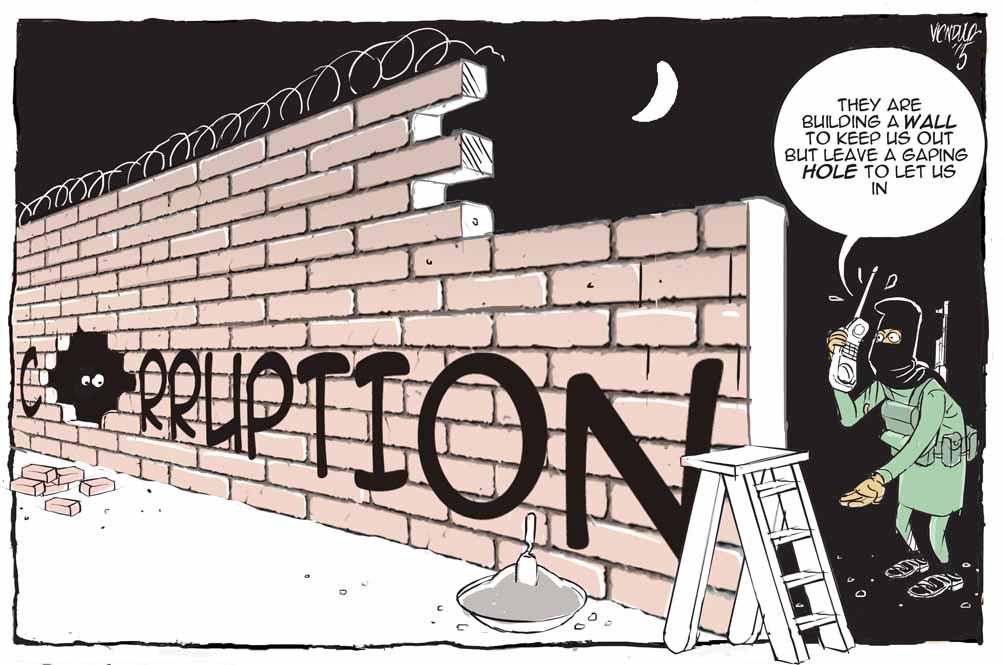
Kenya this week began building a
barrier along its entire border with Somalia, in a purported effort
to prevent incursions by fighters from al-Shabab, an insurgency based
mainly in Somalia which has carried out numerous attacks in Kenya,
including the 2 April shooting of 147 students in the Kenyan town of
Garissa.
This massive project has generated heated debate. IRIN has
gathered a range of views.Deputy President William Ruto said the fence would stretch 700 kilometres. ‘‘Whatever it is going to cost us and whatever it will take, we are going to make sure that our country is safe,” he added in a televised speech.
Interior Ministry Spokesman Mwenda Njoka told IRIN that the barrier would be built by the National Youth Service under the supervision of the army.
He also said:
“The wall is basically meant to limit illegal crossing and monitor movement of people. People with legal documents will be allowed to cross as security agents capture their data. We want to know specifics of people, why they are moving from country to country and what their intentions are.
“It will involve a combination of putting up obstacles and digging trenches, especially in areas which are not navigable, to prevent people from crossing into and from the country. There will be CCTV cameras powered by solar and a control centre manned by border patrol units, where information on possible threats will be received, tabulated and action taken in real time. Some areas will have electric fences.
“There will be designated points for people to legally use while entering or leaving the country.
‘‘Government security agents believe al-Shabab combatants do not live in the country [Kenya], but rely on Kenyan recruits to do logistics for them.”
George Morara, Vice Chairman of the Kenya National Commission on Human Rights, said constructing the barrier was an “exercise in futility."
He added:
“It is a monumental waste of tax-payers' money. Where similar walls have been built or exist to keep out the so-called ‘undesirables’, they have not been successful. Case in point, Israel’s wall to keep out the Palestinians has not stopped the attacks against Israel. They have only led to more creative ways of circumventing the barrier, through for example, the building of underground tunnels by Palestinians as conduits of attack against Israelis. Also, the mighty American wall on the US-Mexico border has not stopped Mexicans who are determined to get to the US from scaling the seemingly impregnable wall.
“The building of the wall presupposes that al-Shabab is exclusively made up of ‘external enemies’ who are hell-bent on attacking Kenyans. The recent terror attack [in Garissa] only served to confirm what has always remained a known fact in the country: that the militant group is actively recruiting young and disenchanted Kenyans into its radical and extremist views.
“What we need to do as country is … create opportunities for gainful employment for the youth and… do all we can to eliminate corruption within our security agencies as this remains a big contributor to Kenya's vulnerability to terrorist attacks.”
Abdirashid Hashi, Executive Director of the Heritage Institute for Policy Studies, a Mogadishu-based think tank, said he understood Kenya’s “urge to do something, anything about the [al-Shabab] menace.”
He added:
“However, what Kenya needs is to pause and devise a long-term strategic plan to cope, deal and mitigate this clear and present danger - which is a decade old now and might take another decade to eradicate. Both Kenya's initial decision to send troops to Somalia and its current policies such as closing remittances or announcing mass deportation of legal refugees, or branding the loudest anti al-Shabab Islamic scholars , comes across as reactionary decisions made by panicky politicians.
“Kenya's best bet to overcome the serious threats posed by al Shabab lies with its ability to harness the ingenuity of its Somali and Muslim citizens and making them lead the battle against al Shabab and working closely with Somalia -- the source and the main theatre of the menace. Unfortunately Kenya now seems to have bypassed such a path and is engaged in sabre-rattling, refugee-chasing and lashing out at potential partners in its struggle to defeat al-Shabab.”
David Anderson, Professor of African History at the University of Warwick, described the barrier as "a crazy idea."
“Are we going to keep al-Shabab in [Kenya], or are we going to keep them out? The problem, at this stage is inside Kenya.
"The wall I assume, is more intended with dealing with refugees, but it’s a ridiculous idea.”
IRIN also spoke to a number of Somali
refugees and ethnic Somali Kenyans:
Abdi Ahmed, Somali refugee from Baled Hawa
“I don’t think this wall will change the situation, it will only create division among neighbouring Somalis. Some of my family live in Baled Hawa [in Somalia] and their main trading partner was on the other side, in [the Kenyan town of] Mandera. They will suffer financially and end up refugees like me."
Dubad Mohamed, Somali refugee from from Kismaayo
“If the main reason why Kenya is building the wall alongside the border is security, then let it go on; we the refugees need peace, we suffered as Kenyans are suffering.”
Malyuun Koriyow, resident of Nairobi’s Eastleigh district
“I think the wall is a waste of money and resources. The government should invest in police and their equipment rather than a wall which will cost tax-payers huge sums of money.”
Mohamed Ahmed Farah, Eastleigh resident
“I think this wall Kenya wants to build is like that wall of Israel and Palestine: it is an apartheid wall. Kenya has the right to protect its citizens, but not [with] this wall. It is dividing ethnic Somalis.
“Al-Shabab is everywhere. Kenya should invest in intelligence and cooperating with the locals if it wants to defeat al-Shabab”
from here
Socialism - One World - One People
 |
| FOR WORLD SOCIALISM |
In terms of wealth distribution, South Africa is the second
most unequal society in the world. The gap between those who have, and those
who don’t is staggering, and it stands in the way of a widespread sense of
unity. The small green identity document that signals South African citizenship
is no guarantor of belonging when one out of four citizens are jobless.
With every outbreak of xenophobic violence in South Africa,
the refrain is the same: ‘The kwerekwere are stealing our jobs’ The xenophobic
populism was reflected in statements by the ruling party, the ANC. Nomvula Mokonyane, the Minister of Water and Sanitation,
commented on Facebook that in Kagiso, Gauteng province “almost every second
outlet (spaza) or even former general dealer shops are run by people of Somali or
Pakistan origin… I am not xenophobic fellow comrades and friends but this is a
recipe for disaster”.
Small Business Development Minister Lindiwe Zulu has also
said that “foreigners need to understand that they are here as a courtesy and
our priority is to the people of this country first and foremost… They cannot
barricade themselves in and not share their practices with local business
owners”.
“The idea that people are here ‘stealing’ jobs and that they
don’t have a right to be here needs to be corrected,” says Dr Zaheera Jinnah,
an anthropologist and researcher at the African Centre for Migration and
Society (ACMS) at Wits University. Jinnah said that there were misconceptions
about the size of the international migrant community in South Africa: “There
is a disconnect between perception and reality largely because there hasn’t been
data available until now. A lot of what has been said and reproduced is based
on hearsay and anecdotal evidence or myths.”
The Migrating for Work Research Consortium (MiWORC), an
organisation that examines migration and its impact on the South African labour
market, released two studies last year. They found that 82% of the working
population aged between 15 and 64 were “non-migrants”, 14% were “domestic migrants”
who had moved between provinces in the past five years and just 4% could be
classed as “international migrants”. With an official working population of
33,017,579 people, this means that around 1.2 million of them were
international migrants. A racial breakdown of the statistics reveals that 79%
of international migrants were African, 17% were white and around three percent
were Indian or Asian.
The research consortium also found that Gauteng province,
which contains Johannesburg, had the highest proportion of foreign-born
workers, with around 8% of the working population having been born in another
country. Limpopo and Mpumalanga had the next highest proportion of international
migrants at 4%, followed by North West (3%), the Western Cape (3%), Free State
(2%), Northern Cape (1%), Eastern Cape (1%) and KwaZulu-Natal (1%).
According to the MiWORC data , international migrants in
South Africa have much lower unemployment rates than others. This is unusual.
In most other countries, international migrants tend to have higher
unemployment rates than locals.
South Africa’s unemployment data shows that 26.16% of
“non-migrants” are unemployed and 32.51% of “domestic migrants” are unemployed.
By comparison, only 14.68% of international migrants are unemployed. But while
international migrants are less likely to be unemployed, most find themselves
in positions of unstable, “precarious employment”, unable to access benefits or
formal work contracts. International migrants in South Africa are more likely
to take jobs that locals are not willing to do, or find work in the informal
sector. According to the MiWORC research, 32.65% of international migrants are
employed in the informal sector in South Africa compared to 16.57% of
“non-migrants” and 17.97% of “domestic migrants”. The studies suggest this is
because the informal sector offers the lowest entry cost into the labour
market. The majority of international migrants also come from African countries
which have large informal sectors. According to the research, international
migrants are far more likely to run their own businesses. Eleven percent are
“employers” and 21% are classed as “self-employed”. By comparison, only 5% of
non-migrants and domestic migrants were employers, and only 9% of non-migrants
and 7% of domestic migrants were self-employed.
Late last year, the Gauteng City-Region Observatory – a
collaborative project between Wits University, the University of Johannesburg and
the provincial government – conducted a limited survey of the informal sector
in Johannesburg. Dr Sally Peberdy, a senior researcher at the Observatory –
says that the belief that international migrants dominate the informal sector
is false. “We found that less than two out of 10 people who owned a business in
the informal sector in Johannesburg were cross-border migrants.” Peberdy argues
that international migrants play a positive role in South Africa. “The evidence
shows that they contribute to South Africa and South Africans by providing
jobs, paying rent, paying VAT and providing affordable and convenient goods.” The
Observatory’s study found that 31% of the 618 international migrant traders
interviewed rented properties from South Africans. Collectively they also
employed 1,223 people, of which 503 were South Africans.
Life in townships like Soweto is blighted by severe
under-development. A World Bank survey last year found that about half of South
Africa’s urban population live in townships and informal settlements,
accounting for 38% of working-age citizens, but nearly 60% of its unemployed. Themba,
a South African, said that people weren’t spending money the way they used to.
“In one day I sell stuff worth 120, 150 rand [roughly 10-12 dollars],” he said,
pointing to a table laden with cheap cosmetics and accessories. “Foreigners
take business away from us,” he said. “I still have to eat from there. My
profit is not big,” he said. “I have to walk to my house every day. I think the
government could help us to make stalls here on the pavement and give us
running water, and toilets.
Africans living in other countries which are not their
countries of origin are grimly accustomed to invectives like "fucking
foreigner"; "parasite"; "alien"; "refugee" making
nonsense of the phrase "Africa for the Africans". In the past when
Africa did not have artificial boundaries such as there are today, wars and
hatred were not as rife. Therefore it appears that dismantling the boundaries,
drawn up by non-Africans, would minimise violence. But will that abolish
xenophobia? No. As it is the problem of "the haves and have-nots"
which is central to war, violence and hatred. Thus the real solution will be to
eliminate the present situation of a minority owning the means of production
and distribution of wealth whilst the majority owning nothing, have to work for
the few.
The reasons for the internecine violence are almost always
the same. "Patriotic" citizens are quick to assert,
nationalistically, that the "aliens" have come to take over their
country, their resources, their jobs, their culture, and what have you. Though
the grievances of the masses may be related to economic factors, it is
unreasonable to blame it on their fellow poor. Xenophobia cannot be divorced
from the economic life of the masses. But how the one influences the other is
what most people fail to understand. This can be explained from a
two-dimensional plane: official policy and mass reaction. A party in power is
in reality the executive committee of the rich people behind it. Such a party
therefore rules in the interests of the owners. All its policies are consequently
aimed at the welfare of the rich. Now, since there will arise a conflict of
interest between the rich owners and their poor followers, the ruling party or
government will have to spend huge chunks of the country's money on arms,
maintenance of the army, the police, prisons, etc to hold down the masses so
that the rich can make their profits without hindrance. In the process basic
necessities such as food, shelter, healthcare, education are underfunded. The
little that is provided can only be afforded by the rich. The result,
undoubtedly, is discontent, alienation and disobedience among the masses. In
order to ward off unrest various tactics are employed by governments. One of
them is creating divisions among the suffering masses by, for instance, blaming
foreigners and whipping up nationalistic feelings. This diverts attention from
misrule and mismanagement. The masses who are hungry, sick and illiterate are
taken in by the government's ploy. Now, since a hungry man is an angry man and
since anger is emotional and overpowers reason, the least provocation can
result in violence-often misdirected.
We are all members of the world working class and have a
common interest in working together to establish a world without frontiers in
which the resources of the globe will have become the common heritage of all
the people of the world and used for the benefit of all. In other words money,
buying and selling, commodities and the like must be done away with. Humanity
must commonly own the means of production and must have free and equal access
to the produce. Under such circumstances there will be no want and consequently
no war and hatred. But this type of system can only be possible when people
make efforts to understand it. When they understand and want it, they can
organise to usher it in.
.jpg) |
| FOR WORLD SOCIALISM |
Sunday, April 19, 2015
Europe's Xenophobia

While world attention is focused upon the xenophobic riots against foreigners in South Africa that many claim was instigated by politicians such as the Zulu king, the United Nations draws attention to the shameful complicity of governments in the deaths of many hundreds of migrants and refugees in Europe.
Anti-immigrant rhetoric from politicians across Europe, including Britain, is blocking attempts to introduce large search-and-rescue operations in the Mediterranean that would save large numbers of migrant lives, Laurens Jolles, the United Nations High Commissioner for Refugees (UNHCR) representative in Italy, has warned. Jolles said political expediency was preventing measures being taken to reduce migrant deaths. “In many countries in Europe at the moment, the [political] dialogue and the rhetoric is quite extreme and very irresponsible,” he said. Jolles said: “Because of elections and because of the economic crisis, it becomes difficult for those parties who traditionally would not follow on those same lines to counter the rhetoric with the strength that they should.
“It’s a fear of foreigners, which is a logical fear, a natural fear, but it is being exploited for populist or political reasons, especially in election periods.” He continued, “The level of this dialogue compared to 20 years ago is just incredible. It wouldn’t have been possible in the past, the racist rhetoric, the rhetoric of intolerance. In the 60s, 70s and the 80s, we would never have accepted this,” said Jolles.
The UK Foreign Office says it will not support future search-and-rescue operations because they encourage migration. “The fact that the UK has made it clear that it does not wish to participate in contributing measures to a rescue operation, or putting in place a rescue operation in the Mediterranean, is very concerning,” said Jolles.
In December, the UNHCR appealed to the EU to provide 130,000 resettlement places for Syrians displaced by the civil war. Germany has pledged to take 30,000 and Sweden 2,700. The remaining 26 EU states are taking 5,438 between them, with Britain taking just 143.
“The UK should be participating and contributing in a European context to solidarity measures and trying to fulfil its part making it easier to deal with these [migration] flows,” said Jolles. “If one really wants to tackle the problem and ensure that there are less deaths, then the thing to do is to look at providing legal avenues to come to Europe. There is an obligation, both moral and legal, to try and do something. People will die.”
The UNHCR is concerned that rather than helping to create a safe passage for migrants, the European commission is more concerned with trying to stop people entering. “What we are hearing is that there is more dialogue on how to prevent people coming to Europe and how to stop them than how to manage the flows and what to do when these persons come into Europe,” said Jolles.
In order to ward off unrest various tactics are employed by
governments. One of them is creating divisions among the suffering masses by,
for instance, blaming foreigners and whipping up nationalistic feelings. This
diverts attention from misrule and mismanagement. Secondly, and in response to
the official lies, the masses who are hungry, sick and illiterate are taken in
by the government's ploy. Now, since a hungry man is an angry man and since
anger is emotional and overpowers reason, the least provocation can result in
violence-often misdirected. Such violence can be vented against fellow citizens
usually manifested in riots and civil wars. The violence is also invariably be
turned loose on the "aliens". This is the real cause of xenophobia-the
rich pitting the poor against the poor. In fact wealthy "foreigners"
are rarely affected.
The real solution will be to eliminate the present situation
of a minority owning the means of production and distribution of wealth whilst
the majority owning nothing, have to work for the few. In other words money,
buying and selling, commodities and the like must be done away with. Humanity
must commonly own the means of production and must have free and equal access
to the produce. Under such circumstances there will be no want and consequently
no war and hatred. But this type of system can only be possible when people
make efforts to understand it. When they understand and want it, they can
organise to usher it in.
South Africa and the EU are not very much different in essence when their ruling class seek to divide and rule, even if both vehemently deny that charge. The facts and evidence says otherwise.
Saturday, April 18, 2015
We all belong
National-chauvinism is rearing its ugly head in almost every
sector of South African society. The thing with national-chauvinism is that it
is in permanent need of scapegoats. It starts with those who are not our kin.
But, very quickly, it turns fratricidal. It does not stop with "these
foreigners". No amount of national-chauvinism can erase the fact that no
African is a foreigner in Africa; despite our foolish national boundaries,
Africa is where we all belong.
It starts with the usual stereotypes - they steal our jobs;
they do not respect us; they are darker than us; they are used by whites who
prefer to exploit them rather than employing us.
The South African government has recently taken a harsh
stance on immigration. New, draconian measures have been passed into law. Their
effects are devastating for people already established here legally. Work
permits not renewed. Visas refused to family members. Children in limbo in
schools. A Kafka-esque situation that extends to "foreign" students
who entered the country legally, had their visas renewed all this time, but who
now find themselves in a legal uncertainty - unable to register, and unable to
access the money they are entitled to and that had been allocated to them by
foundations. Through its new anti-immigration measures, the government is busy
turning previously legal migrants into illegal ones.
Instead of spilling black blood we should all be making sure
that we rebuild this continent and bring to an end a long and painful history.
By Achille Mbembe, a research professor in history and
politics at the Wits Institute for Social and Economic Research (Wiser).
Thursday, April 16, 2015
Join Together

Police Minister Nkosinathi Nhleko said during a briefing on
the attacks, "It is African-on-African. It is not on other nationalities."
The fact that foreign nationals from Pakistan and Bangladesh have been profiled
in this wave of attacks, it will soon no longer be enough for South Africans to
cry “Afrophobia.”
Africans, who supported the country's liberation, are being
rewarded with beatings and burnings. A disappointing failure of the African
solidarity. Immigrants are blamed for taking jobs and opprtunities from locals.
Many of them have been forced to close their shops. Zulu King Goodwill
Zwelithini said that foreigners should
"pack their bags" and many of those rioting were heard chanting
"the king has spoken". Migrants are being rounded up and some burnt
alive - including a child. In another a man is dragged on the streets naked and
then stoned. They are calling fellow Africans “kwerekwere”. Pejoratively, the
term “foreigner” in South Africa usually refers to African and Asian
non-nationals.
The press didn't help any. The country's largest weekly
screamed that there were 8 million illegal immigrants. Statistics that have yet
to be substantiated. Other papers, relieved that Black people were now being
seen as bigots, become the champions of the poor downtrodden Africans. This
narrow-mindedness, suffered by both black and white South Africans, is a
by-product of apartheid. For black people, apartheid was an insidious tool used
to induce self-hate and tribalize people of the same race. For white South
Africans, apartheid was a false rubber-stamp of the white race as superior. It
is these two conceptions that gave rise to the myth that South Africa is not
part of the African continent, but a different place that just happens to be on
the tip of the continent. Long after the scourge of apartheid, it is also clear
that we’re fueling this prejudice in the present.
White expats in South Africa don't get accused of stealing
jobs. Foreigners—particularly those from the Americas and Europe go
unnoticed—they are often lumped up with “tourists,” or even better, referred to
as “expats.” It is this reason why the South African government says its
hesitant to call the recent attacks on foreign nationals as xenophobic
In the mining cities and towns the problem has been there
for much longer. Workers have been imported from Mozambique, Zimbabwe, Lesotho,
and Swaziland to work in mines for over 50 years. When workers came to the
cities to work, they were segregated according to community. For a long time
there weren't any problems. Then the layoffs started. Gold prices plummeted,
recession hit. The riots and upheavals of the 80s encouraged the mining houses
to invest more in foreign labour. South Africans were 'troublesome'. As workers
across the country started to unionise, labour from nearby countries became
more attractive. They didn't strike. They would accept less wages. They were
docile. They could be deported.
South Africa’s xenophobia reflects the country’s history of isolation.
As a country at the southern-most tip of Africa, South Africans are fond of
referring to their continental counterparts as “Africans” or “people from
Africa.” Many business ventures, news publications and events—aimed at local
audiences—routinely speak about “going to Africa.”
Saturday, April 11, 2015
End the Division

Once more in the wake of comments by the Zulu king
telling migrants to go home we witness shameful scenes of hatred in South
Africa. Following the alleged remarks by King Goodwill Zwelithini where he reportedly
said that foreigners were changing the nature of South African society as they
were taking advantage of the poorly behaved and undisciplined locals. Zwelithini
was also quoted as saying, “We urge all foreigners to pack their bags and
leave”, 250 people have been attacked, mostly from the
Democratic Republic of Congo, and foreign-owned shops have been looted in the
port city of Durban. South African President Jacob Zuma's son, Edward, has come
out in support of the Zulu king's alleged comments, accusing foreigners of "taking
over the country". He said foreigners were fuelling South Africa’s drug
problem.“They are the reason why there are so many drugs in the country. They
supply and sell the drugs to communities in our country."
More than 1,000 mainly African migrants have fled their
homes, some going to police stations and other are being housed in tents on a
sports field. “They said they were intimidated to vacate their homes by locals
and came to us because they feared for their lives,” police spokesman Thulani
Zwane said. “Most of the shops belonging to foreigners in trouble areas have
been abandoned and now criminals are breaking in and stealing everything they
can carry away,” Zwane said.
South Africa's
Business Day newspaper reports that at least three people have been killed and
that a Somali shopkeeper is in a critical condition. Police yesterday broke up
a march by a group of foreign nationals who were protesting against the
violence, firing water cannons and tear gas. Police said the march was illegal.
Spokesman Eugene Msomi said the crowd had to be dispersed when they failed to
follow orders to do so. “They were informed in writing the day before not to
march due to prevailing safety concerns,” Msomi said.
As Africa’s most industrialized nation, South Africa
attracts thousands of foreigners every year, seeking refuge from poverty, economic
crises, war and government persecution in their home countries. While the bulk
of them are from elsewhere on the continent, such as Zimbabwe, Somalia and
Ethiopia, many come from South Asia. Economically disadvantaged South Africans
see foreigners as competing with them for business and jobs. Locals and African
immigrants compete for scarce jobs, making them a target for violence and
intimidation.
Monday, March 16, 2015
End the Division

It took Getachew Eriro four months to make his way from
Ethiopia to a South African township and open a little shop selling bread,
sweets and canned fish. It took just a few minutes to lose it all when a mob of
more than 50 residents broke in two months ago, ripping through the roof to
steal his stock and trash the store. He says it was because he’s an immigrant. Eriro
hitchhiked most of the 5,433-kilometer (3,376-mile) distance from his village
near the Ethiopian capital of Addis Ababa to Johannesburg. He fled his home
country in 2009, concerned for what he said was his safety after supporting an
opposition movement to Ethiopia’s ruling party. As the eldest of seven
children, Eriro was charged with earning income to send back home. He chose to
settle in Johannesburg because he had distant cousins there who said they would
help give him a head start. Opening a business wasn’t too hard: No formal
registration or licensing is required to operate a convenience store, known as
a spaza, from a home. And spazas enjoy support in the community. Eriro lost all
his clothes and personal possessions in the attack, including photographs and
immigration papers. He won’t be able to send any money home until he repays a
30,000 rand ($2,536) loan he got from a friend to restock his shop and replace
three refrigerators that were stolen. With debt to repay, Eriro said his only
option is to keep his business open despite the hostile environment.
South Africa is in the midst of anti- immigrant violence. The
violence reflects South Africa’s failure to live up to the ideals of a
constitution admired around the world for protecting those rights and to
provide hope for a better economic future for its citizens. It’s a tragic turn
of events for a country whose 21-year- old democracy was created to uphold
equal treatment for all, regardless of race or background.
Roland Henwood, a political science lecturer at the
University of Pretoria explains: “Many people are so destitute and marginalized
that they cannot see themselves achieving and making use of the opportunities.
Therefore they prevent others from gaining that kind of advantage.”
In overcrowded, poverty-stricken townships, competition for
resources is high. Many residents survive on a monthly state welfare grant of
330 rand for children this year up to the age of 18 or 1,410 rand for
pensioners. While the official national jobless rate is 24 percent, it stands
at 35 percent if people who’ve given up looking for work are included.
Soko, 30, a resident of Snake Park for 10 years said “I
think people are driving their own interests against foreigners, and not
necessarily for the betterment of the community here.”
Saturday, February 21, 2015
Rainbow Nation?

Yet when the Sunday Times visited Ramaphosa three weeks ago,
we tracked down an eyewitness who pointed out two of the main suspects in the
crime. The woman sees the killers at least once a week. Her recounting of
details surrounding Nhamuave's death has remained consistent for nearly seven
years, when she first revealed details of the murder. At the time she was
willing to speak to police. "But the police never came here. Now, I don't
trust the police here," she said.
On May 18 2008, Sipho was part of a mob intent on chasing
foreigners out of the settlement. "He's the one who stabbed him. He stood
over him when he was down and stabbed him, like this," said the witness,
motioning downward with a two-handed grip. The mob then wrapped their victim in
his own blankets and tried to set him alight. They failed. Bheki*, another
attacker, walked to the traffic circle, where a fire was burning, and returned
with a flaming piece of wood, which was placed under the man. "Then it
worked. He was on fire," the witness said.
Concerns about livelihoods seem similar to cases of
xenophobia everywhere else in the world where people seek scapegoats for their
deprivation. Unemployment rocketing from 13 percent in 1994 to 25 percent in
2013, or 40 percent by unofficial measures. According to the Economist, “half
of South Africans under 24 looking for work have none. Of those who have jobs,
a third earn less than $2 a day.” Since 1994, the number of people living on
less than one dollar a day has doubled, from 2 million to 4 million. Two
million people have lost their homes because of forced removals and inflated
rents, and the number of shack dwellers has increased by fifty percent, to the
point where today more than one quarter of South Africans live in shacks. The
argument holds that as livelihoods become ever more precarious, competition
over jobs, housing, and retail have reached extreme levels. In the face of this
mounting competition, people seek to leverage whatever social distinctions are
most readily available in order to lay claim to diminishing resources. In the
context of post-apartheid South Africa, those who believe they have the right
to benefit from the promised—but as yet unrealized—fruits of liberation draw
lines between themselves and the non-citizens who they believe should not have
such a right. The primary problem with immigrants according to local people is
that they undermine the economic opportunities of local citizens. According to
my interlocutors, they do this by both outcompeting South African–owned
businesses in the informal economy, and by undercutting the labor market by
working for rates far below the minimum wage, allegedly as low as R25 per day.
Thus the ubiquitous complaint that “foreigners are stealing our jobs.” The
strength of this xenophobia is the fear of the unknown”. Add to this the fact
that people are competing against their neighbors for scarce jobs in a context
in which livelihoods are increasingly precarious, and you have a recipe for
disaster. People are forced to establish claims to limited resources by
defining the others who do not belong, who should not belong, and who never can
belong. In other words, by xenophobia.
In addition to job
theft, the men also accused foreigners of stealing their women by wooing them
with cash, outdoing the local competition because they have fewer financial
responsibilities to kin. Marriage rates, down to less than half of 1960 levels,
so that today only 3 of 10 South African adults are married. With unemployment
rates as high as they are, most young men find it impossible to raise the
resources they need to pay lobola (bridewealth) and establish their own
legitimate, respectable homes. They suffer from a crisis of masculinity, having
been expelled from the path to manhood that was encouraged under apartheid—that
of becoming umnumzane, a respectable, working-class family man. Instead, they
find themselves in their thirties and still living with their mothers, earning
the social derision due to umnqolo—a “mamma’s boy.” Immigrants are accused of
being able to make do with very little money for wages because they come here
with no responsibilities. If they get R25 per day they have enough to eat. They
don’t have responsibilities. They don’t have wives. Residents accuse immigrants of hoarding their
money without reinvesting it in the community through exchange. People accuse
them of impregnating local women without paying bridewealth or cleansing fines
(inhlawulo). Immigrants are perceived to traffic in the pure commodity,
accumulating only for themselves while avoiding entanglement in relationships
of reciprocity, in stark contrast to South Africans who are increasingly
burdened by debt obligations. This representation is inaccurate, of course, as
most immigrants remit to their home countries and are deeply embedded in
transnational kin networks, while many young South African men father children
without providing for them. Yet the stereotype retains its power.
Why are foreigners so often killed by burning? Why are they
not lynched or beheaded? In the 1990s, young unemployed males burned
accused-witches while chanting the words “Die, you witch; we can’t get jobs
because of you!” Foreigners use witchcraft, or, in IsiZulu, ubuthakathi. Just
like witches, immigrants are said to participate in forms of accumulation that
are considered immoral and anti-social, enriching themselves at the expense of
others. This makes it not only thinkable for people to orchestrate violence
against immigrants, but also gives the violence the aura of legitimacy, for it
appears to be in the service of morality.
Taken from here
Friday, January 30, 2015
Understanding Migration

The “fear” of being swamped by foreigners is easy to
mobilise on the social or political agenda as a social and security issue.
Often, this fear fuels public perceptions in host countries that migrants
increase employment competition, challenge religious, cultural or ethnic
homogeneity, increase crime or threaten national security. This may result in
xenophobic attacks, as seen by the unfortunate situation playing out in Soweto.
Are these fears justified? If all the migrants in Soweto were to vacate, will
the socio-economic problems of that community’s problems depart with them? Are
these migrants not an easy target and temporary catharsis for a community
frustrated and disenchanted with lack of state delivery and opportunities?
We still come across figures and estimates which state that
for example the number of Zimbabweans living in South Africa is between a one
million and four million. Zimbabwe has a population of about 14.15 million. At
the high end of these estimates, it means at least a third of Zimbabweans live
in South Africa, a dubious claim. According to Chiumia 2013, a report published
on the website of SW Radio Africa, it stated that there are between two and
three million Zimbabweans living and working in South Africa. Interviews
conducted by the Inter Press Service news agency stated that the number of
Zimbabwean nationals crossing the border have almost doubled since elections in
Zimbabwe. What is often missed by these studies is that “crossing the border”
is not a single event but a continuous process. By far, the vast number of
people who cross the border into South Africa are also those who cross it back
to Zimbabwe and other regional countries within days, weeks and at most a few
months. Contemporary cross-border migration within southern Africa, better
understood as transnationalism is not premised on permanent settlement in the
receiving country but is highly circular comprising of migrants having a
foothold in both sending and receiving countries and constantly shuttling
between the two.
It takes its cue from historical intensive intra-regional
migration dating back to the mid-nineteenth century when new industries were
introduced that generated sustained interdependence between labour-supplying
and labour-receiving countries in the region. The story of social
transformations in the region, therefore, is fundamentally the story of
migration; it is the story of human movements that continue to pervade the
entire region unhindered by colonial boundaries. No wonder southern Africa has
been described as a region on the move. Most cross-border practices by
Zimbabweans have occurred in Botswana and South Africa and by Zambians and
Mozambicans in Zimbabwe and by Malawians in Zambia and Tanzania. Despite the
Southern African Development Community’s rhetoric of free movement in southern
Africa, cross-border migrants continue to highlight the tension between the
tendency of states to define space as “territory’-accentuating control, order,
and security and the tendency of individuals to associate space with
“soil”-emphasising free movement, shelter, and subsistence. To migrants,
southern African borders are not barriers but windows of opportunities.
These opportunities require migrants to live their lives
across various locations. Hence transnationalism is composed of a growing
number of persons who live dual lives, sometimes speaking two languages and
making a living through continuous regular contact across national borders.
Leading transnational, multi-sited lives means that exchanges and interactions
across borders are a regular and sustained part of migrants’ realities and
activities. This means South Africa is but one of many regular destinations in
the transnational migrant portfolios, a regular pit-stop in a nomadic life that
might include Botswana, Tanzania, Zambia, Namibia, Dubai and China in the
destinations portfolio. These migrants make a living by exploiting the
differentials in supply and demand of merchandise, products, seasonal labour
among other goods and services across regional and international borders.
Thus migrant-owned spaza shops are not only in Soweto but
scattered throughout the region together with flea markets, various import and
export enterprises, buying and re-selling businesses among other ventures that
feed into the regional informal trade and social network. Transnationalism
speaks to a “condition of being”, a condition of constantly shuttling to and
from sending and receiving nodes. As such, this movement is so encompassing as
to virtually erase the distinction between “here” (home) and “there” (host
state). Consequently, transmigrants cannot be neatly placed, they are neither
for example, in Zimbabwe nor in South Africa, they are a moving target. This
makes home and host society a single arena of social action, a third space
between and across state borders. Such “third spaces” or migrant “imagined’
communities represent a theatre where kinship, social networks, cultural
trends, and visions of individual and familial futures are enacted. A
semi-autonomous space, isolated from the national order of things and populated
by increasingly “sovereignty free” individuals whose only link back to the
state is a passport.
What does this mean for identity in southern Africa? For
traditional citizenship based on continuous residence in a given territory, a
shared collective identity and participation in and subjection to a common
jurisdiction? What does this mean for migrant identities traditionally
associated with settlement in host states? What does this mean for outdated
policies and approaches obsessed with quantifying migrants in host countries
and inflaming fears of “migrant tsunamis”? We ought to re-think our approaches
to migration and realise that permanent settlement and inclusion in host
societies are no longer the outcomes of much contemporary migration within the
region. Current conditions of flexible accumulation and globalisation economic
practices militate against a facile incorporation into a national imaginary. Transnational
migrants see southern Africa as a single arena of social action rather than
territory divided by boundaries into states. We should realise that
embeddedness in cross-border exchange is now a normal part of people’s
contemporary social statuses. Transnational migrants are thus front-runners and
actors in the regionalisation project with southern African states and state
policies lagging behind, hamstrung by narrow, parochial and inward-looking
interests. Transnational migrants in southern Africa expose the fiction of
state sovereignty daily as goods, people, capital and resources flow freely and
continually throughout the region creating flourishing informal sectors that
ignore borders and evade taxes. This alludes to the waning of state and society
convergence. Migrant third spaces offer an invitation to rethink the concepts,
foundations and boundaries of states and identity formation. They represent
tentative alternative locations of community, identities, economic, social and
political (in)security that exists alongside, across and in competition with
states. This makes scenario building for southern Africa’s future outlook an
interesting project.
Friday, January 23, 2015
South Africa's 'xenophobic' attacks Return
In 2008, more than 60 people were killed in a series of
attacks on foreign nationals. In 2013, a 25-year-old Somali man died after
being dragged through the streets of Port Elizabeth, and pelted with stones and
rocks.
Police have arrested at least 121 people in connection with
violence and looting of foreign-owned stores in Soweto township
in Johannesburg that resulted in the death of at least two teenagers ,
prompting fears of renewed xenophobia in the country. Residents of the township
attacked foreign nationals after a teenager was allegedly shot dead by a Somali
shop owner earler in the week. The 14-year-old was allegedly part of a group
that had tried to rob the shop. Riots and looting spread to other parts of
Soweto, and another teenager was killed amid the violence. Locals targeted
Somali, Ethiopian and Pakistani-owned shops in the area, forcing foreign shop
owners to leave the area out of fear.
Thursday, January 08, 2015
South Africa's Afrophobia
This year looks set to be another gloomy one for asylum
seekers, as the ANC government makes a renewed attempt to deport and restrict
the number of African migrants to South Africa. Black Africans are not welcome
anywhere, even as tourists, and must jump through dozens of hoops to apply for
visas to enter almost every country in the world to prove their worthiness. It
has become fashionable for governments globally to decry the fact that people
of colour are seeking asylum when in fact they are 'economic migrants' making
contrived claims of persecution. Given the Black South Africans experience
indignities when applying for visas to Europe, Australia and North America, it
is continually disappointing when the ANC government concocts new ways to keep
other Black Africans out of South Africa.
A strange new form for asylum seekers now compels applicants
to provide pay slips, details of property owned and to reveal how much money
they have. It is still not known what this information will be used for, since
governments are only supposed to assess applications for asylum based on the
level of persecution faced in the home country - not the amount of money in the
applicants' bank accounts. In 2013, only two out of 12 000 applicants were
granted asylum and the new 'asylum seekers' form is likely part of government's
quest to rid South Africa completely of genuine asylum seekers and allow in
only those with money.
In South Africa, an estimated 50 000 Zimbabweans are facing
deportation soon for failing to apply for permission to stay in South Africa
under the new 'Zimbabwean Special Permit' system. Every four years or so, the
South African government attempts to get rid of Zimbabwean migrants but instead
succeeds only in creating fear, panic and ultimately highlighting the
deficiency of its own systems.
In 2010, the government gave just three months warning that
it would end a 'special dispensation' for Zimbabweans. This progressive
dispensation was started to allow Zimbabweans free access to South Africa
during the Zimbabwean cholera epidemic of 2009, for 90 days at a time without
passports and without fearing deportation. But ending the special dispensation
failed mainly because the Zimbabwean government would not issue Zimbabwean
passports to its citizens in time for them to apply for the permits, and also
because the department of Home Affairs could not process the number of
applications anyway. Similarly, Home Affairs has already admitted that the new
'Special Permit' system for "regularising" Zimbabweans has been
plagued by "a lot of technical glitches", including - again - the
failure of the Home Affairs' call centre to answer thousands of calls from
those who wanted to apply for permits.
Home Affairs' top officials said in 2010 that they planned
to follow the "regularising" of Zimbabwean migrants by documenting
Malawians, Angolans, DRC citizens and others from Africa in the same way. This
has not materialised, thankfully.
No similar race based country-by-country purge was planned
for white migrants from Europe and North America, who are generally prized by
the DA and ANC governments for the "skills" they bring to South
Africa. Institutional racism is deeply embedded in South Africa with the
Commission for Employment Equity's annual report continuing to reveal that
whites still occupy most senior management and top management positions. It is
for this reason that Black Consciousness activists have pointed out in the past
that xenophobia in South Africa is more accurately described as afrophobia, and
that the DA and ANC governments are generally afrophobic.
An astonishing tweet by COSATU general secretary Zwelinzima
Vavi this week, decrying Asian shop owners in townships, indicates how far the
phobia of migrants of colour has spread. "We condemn xenophobia but the
current displacement of Africans even in spaza shops mainly by guys from East
is not politically sustainable", tweeted Vavi. Being the country's leader
of organised workers, Vavi knows better than most that the biggest problem
facing the South African Black working class and poor is not Asian spaza shop
owners in the townships but the out-dated free market system adopted by the ANC
and DA governments. Jobs in manufacturing have been slashed, profits from the
mining industry continue to flow to a tiny elite, and the ANC is dead set
against nationalising even the unallocated mineral deposits, which could fund
the redevelopment of the whole country, let alone the mines themselves.
for Vavi to be tweeting against "guys from the
East", is absurd. Migrant workers are not to blame for the high levels of
unemployment. Vavi's tweet, although made against Asian migrants, will increase
xenophobic sentiment in general, and consequently fuel afrophobia against spaza
shop owners from Africa. Criticism of Asian migrants today quickly leads to
resentment of African migrants tomorrow. Under South Africa's free market
economic system, deporting African migrants and asylum seekers and encouraging
xenophobia against Asian migrants will not uplift the Black poor and working
class whose lives seem set to continue to deteriorate until the ANC and DA
governments are voted out of power completely.
Monday, February 10, 2014
One People
In South Africa, xenophobia is a growing problem, and it is manifesting itself against Africans who are seeking refuge in the country. One in four South Africans is currently unemployed, and many of them fear the foreigners will steal their jobs.
Somali refugee Mohammed left the nightmare of his war-torn home and travelled nearly two-and-a-half thousand miles to South Africa. He came to the country looking for a better life, but instead what he found was violence, poverty and racism. Mohammed is one of a growing number of African refugees who face daily harassment and violence at the hands of local South Africans.
“Since I got here, I faced a lot of problems. They [South Africans] chase us away from where we were living and where we set up businesses. They come in a group, start looting our stuff, and kill our people.”
In recent years, attacks against African foreigners have multiplied, leaving dozens dead. Thousands of Somalis, Ethiopians, Zimbabweans and Mozambicans have fled to South Africa, attracted by the relatively strong economy.
Imacal Tafesel, an Ethiopian refugee, runs a small stall selling clothes, and blames the police for not doing anything to stop the xenophobic attacks. He said that often, it is the police who are behind such attacks. “Once, seven police officers came to my shop and took my stuff. Most of the police here don’t like us. They tell us to go back to our countries,” said Imacal Tafesel.
In South Africa, many people live in extreme poverty. Alexandra township, just outside Johannesburg, is home to nearly half a million people with limited resources.
Domestic worker Mavis Makama was born in South Africa, and struggled for years to get her current job. Even though she earns just a minimum wage, it is a lifesaver for her. “It’s very hard to find a job here, because the people from Zimbabwe, they come here to take our jobs. And now that I must look after my son, it is very difficult for me,” said Mavis Makama.
The solution is not to seek to blame other victims but to understand the cause of poverty and change the system which permits it.
Somali refugee Mohammed left the nightmare of his war-torn home and travelled nearly two-and-a-half thousand miles to South Africa. He came to the country looking for a better life, but instead what he found was violence, poverty and racism. Mohammed is one of a growing number of African refugees who face daily harassment and violence at the hands of local South Africans.
“Since I got here, I faced a lot of problems. They [South Africans] chase us away from where we were living and where we set up businesses. They come in a group, start looting our stuff, and kill our people.”
In recent years, attacks against African foreigners have multiplied, leaving dozens dead. Thousands of Somalis, Ethiopians, Zimbabweans and Mozambicans have fled to South Africa, attracted by the relatively strong economy.
Imacal Tafesel, an Ethiopian refugee, runs a small stall selling clothes, and blames the police for not doing anything to stop the xenophobic attacks. He said that often, it is the police who are behind such attacks. “Once, seven police officers came to my shop and took my stuff. Most of the police here don’t like us. They tell us to go back to our countries,” said Imacal Tafesel.
In South Africa, many people live in extreme poverty. Alexandra township, just outside Johannesburg, is home to nearly half a million people with limited resources.
Domestic worker Mavis Makama was born in South Africa, and struggled for years to get her current job. Even though she earns just a minimum wage, it is a lifesaver for her. “It’s very hard to find a job here, because the people from Zimbabwe, they come here to take our jobs. And now that I must look after my son, it is very difficult for me,” said Mavis Makama.
The solution is not to seek to blame other victims but to understand the cause of poverty and change the system which permits it.
Monday, June 10, 2013
South Africa's Xenophobia
As the largest economy on the continent, South Africa has attracted foreign Africans from as far afield as Nigeria, Ethiopia, the DR Congo and as close as neighbouring Botswana. They come as political refugees or economic migrants, with one goal: a better life. Following the end of apartheid in 1994, thousands of Chinese and South Asian foreign nationals have been living and conducting business across the country. Despite attracting the biggest number of asylum seekers in the world, The Southern African Migration Project (SAMP) found that South Africans receive foreigners with a jaundiced eye.
Instead of South Africans thriving on its much-vaunted multicultural identity, foreigners have been painted in the popular imagination as criminals, job snatchers, and parasites arriving in throngs to eat at an economy battling to feed its own people. In 2011, around 120 foreign nationals were killed, of whom five were burnt alive. In 2012, 140 foreigners were killed and 250 others injured in violent attacks across the country, reported the African Centre for Migration & Society in Johannesburg. In 2013, the Centre estimates that at least three attacks on foreigners take place weekly. With just one perpetuator brought to justice for the 2008 violence, the South African judiciary is allowing for a culture of impunity to settle, as the foreigner is institutionalised as a soft target, unlikely to enjoy state protection on any level. Foreign nationals entering the country and trying to integrate into society narrate tales of daily strife with authorities. They report harassment at police stations, neglect at hospitals and abuse at immigration offices. The way the state treats foreign nationals essentially represents the way ordinary people treat foreign nationals.
Biniam Misgun, lecturer in the School of Sociology at the University of KwaZulu-Natal, in Durban explained "If people were not fighting over a bag of corn or sugar, it [the situation] might be a little different."
SAMP found that more than 50 percent of South Africans believed foreigners constituted a majority of the country's population while 63 percent of South Africans wanted electrified fences on the country’s borders. In reality, foreign nationals amount to less than five percent, or 2.2 million people out of a population of around 50 million. The study found that xenophobia is firmly embedded across all economic and social strata of South African society but with incidents of violence are more likely in impoverished areas where a riot can sometimes be the only way to the draw government attention. In the township of Diepsloot in Johannesburg was a scene of chaos after a Somali shopkeeper killed two Zimbabweans he suspected to be thieves on the evening of Sunday, May 26. Angered by the shootings, Diepsloot residents turned their attention on the Somalis, Pakistanis and other foreign nationals doing business in the township. Nineteen foreign-owned stores were attacked in a frenzy of xenophobic violence and looting over the next two days. In Port Elizabeth a Somali man, was stripped naked, his genitals pelted with rocks, stones smashed over his head all the while receiving kicks to the face, became the latest victim of xenophobic violence in the country. Abdi Nasir Mahmoud Good, died of his injuries. Good is just one of the victims of the xenophobic violence that flared through northern Port Elizabeth and up to four other towns and cities across the country last week. Five other Somalis were injured in the violence and almost every Somali-owned business in Port Elizabeth’s Booysen Park was burned or looted.
“ South Africa wants to promote solidarity and unity on the African continent and yet there is move towards a more restrictive asylum regime," Sicel'mpilo Shange-Buthane, executive director of the Consortium for Refugees and Migrants , in Johannesburg, told Al Jazeera.
Instead of South Africans thriving on its much-vaunted multicultural identity, foreigners have been painted in the popular imagination as criminals, job snatchers, and parasites arriving in throngs to eat at an economy battling to feed its own people. In 2011, around 120 foreign nationals were killed, of whom five were burnt alive. In 2012, 140 foreigners were killed and 250 others injured in violent attacks across the country, reported the African Centre for Migration & Society in Johannesburg. In 2013, the Centre estimates that at least three attacks on foreigners take place weekly. With just one perpetuator brought to justice for the 2008 violence, the South African judiciary is allowing for a culture of impunity to settle, as the foreigner is institutionalised as a soft target, unlikely to enjoy state protection on any level. Foreign nationals entering the country and trying to integrate into society narrate tales of daily strife with authorities. They report harassment at police stations, neglect at hospitals and abuse at immigration offices. The way the state treats foreign nationals essentially represents the way ordinary people treat foreign nationals.
Biniam Misgun, lecturer in the School of Sociology at the University of KwaZulu-Natal, in Durban explained "If people were not fighting over a bag of corn or sugar, it [the situation] might be a little different."
SAMP found that more than 50 percent of South Africans believed foreigners constituted a majority of the country's population while 63 percent of South Africans wanted electrified fences on the country’s borders. In reality, foreign nationals amount to less than five percent, or 2.2 million people out of a population of around 50 million. The study found that xenophobia is firmly embedded across all economic and social strata of South African society but with incidents of violence are more likely in impoverished areas where a riot can sometimes be the only way to the draw government attention. In the township of Diepsloot in Johannesburg was a scene of chaos after a Somali shopkeeper killed two Zimbabweans he suspected to be thieves on the evening of Sunday, May 26. Angered by the shootings, Diepsloot residents turned their attention on the Somalis, Pakistanis and other foreign nationals doing business in the township. Nineteen foreign-owned stores were attacked in a frenzy of xenophobic violence and looting over the next two days. In Port Elizabeth a Somali man, was stripped naked, his genitals pelted with rocks, stones smashed over his head all the while receiving kicks to the face, became the latest victim of xenophobic violence in the country. Abdi Nasir Mahmoud Good, died of his injuries. Good is just one of the victims of the xenophobic violence that flared through northern Port Elizabeth and up to four other towns and cities across the country last week. Five other Somalis were injured in the violence and almost every Somali-owned business in Port Elizabeth’s Booysen Park was burned or looted.
“ South Africa wants to promote solidarity and unity on the African continent and yet there is move towards a more restrictive asylum regime," Sicel'mpilo Shange-Buthane, executive director of the Consortium for Refugees and Migrants , in Johannesburg, told Al Jazeera.
Friday, September 03, 2010
xenophobia in South Africa
"Xenophobia is part of life. We do not live easy here. We only survive," says Somali shopkeeper, Abdinasir Shaikh Aden. Aden was threatened with his life during the run-up to the Cup. He was chased away from his small grocery shop and told that foreigners would have no future in South Africa once the tourists and fans had gone home.
A dangerous combination of cramped living conditions and competition for jobs remains. The recession and deepening unemployment in South Africa is exacerbating the pressure on poor communities.Overcrowded and poverty-stricken areas are most at risk of a flare-up of tensions.
Liliane Mukangwa, who settled in South Africa with her husband and five children, moving back to the Democratic Republic of Congo (DRC) is not an option."It is hard for us as we have nowhere to go. We do not want to go home. It is too dangerous there." Mukangwa has been living in South Africa for eight years.She travels to her house every day during daylight hours accompanied by family and friends from the DRC. She is scared of travelling alone on public transport: "There is often tension on the trains."
South Africa is to start expelling Zimbabweans again, from 31 December, the government has announced. An estimated two million Zimbabweans are thought to be in South Africa. Human rights groups have condemned the South African government's decision. Zimbabwe exile groups fear that anyone forced to return could still face persecution.
A dangerous combination of cramped living conditions and competition for jobs remains. The recession and deepening unemployment in South Africa is exacerbating the pressure on poor communities.Overcrowded and poverty-stricken areas are most at risk of a flare-up of tensions.
Liliane Mukangwa, who settled in South Africa with her husband and five children, moving back to the Democratic Republic of Congo (DRC) is not an option."It is hard for us as we have nowhere to go. We do not want to go home. It is too dangerous there." Mukangwa has been living in South Africa for eight years.She travels to her house every day during daylight hours accompanied by family and friends from the DRC. She is scared of travelling alone on public transport: "There is often tension on the trains."
South Africa is to start expelling Zimbabweans again, from 31 December, the government has announced. An estimated two million Zimbabweans are thought to be in South Africa. Human rights groups have condemned the South African government's decision. Zimbabwe exile groups fear that anyone forced to return could still face persecution.
Subscribe to:
Posts (Atom)